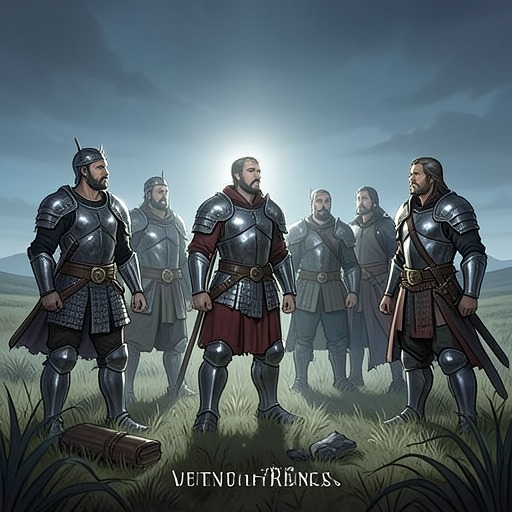
Immortal Words
The Way of KingsImmortal Words are the oath tradition associated with the Knights Radiant and the clearest surviving expression of what made a Radiant more than a person capable of infusing. Their opening Ideal—“Life before death. Strength before weakness. Journey before destination.”—defines a hierarchy of values in which endurance and moral action matter more than mere survival or a final result. The words therefore function both as a creed and as a demand for conduct: they are meant to be lived, not simply remembered.
Definition and First Ideal
The Immortal Words are described as the motto of the Lost Radiants, who used the phrase “Life before death. Strength before weakness. Journey before destination.” as at least part of their public identity. The formulation places three paired values in deliberate opposition. Life is set before death, strength before weakness, and the journey before its destination; the sequence gives priority to active, difficult becoming over passive endings. It is not presented as an abstract slogan detached from action, but as the language by which the Radiants understood the way they were supposed to live.
The First Ideal is the opening portion of the Immortal Words. Teft explains that it is only the first of five, establishing that the tradition has a larger oath structure beyond the words currently known. This distinction matters because the ability to take in Stormlight and command it does not, by itself, make someone a Radiant. Radiance requires a way of life and adherence to the Immortal Words, so supernatural capacity and ethical identity are related but not interchangeable.
Survival, Memory, and Transmission
The phrase first reappears in a grim setting, among dead bridgemen whose vest, sandals, and bodies testify to the human cost of their service. When Kaladin questions whether survival is the point, Teft answers that surrender seems pathetic and argues for continuing to fight until the arrows take them. He invokes the final part of the Ideal—“journey before destination”—without knowing exactly what it means and admits that it is merely something heard long ago. The uncertainty gives the words a damaged, inherited quality: the principle survives even where its history and full significance have been lost.
Sigzil supplies the missing context. He identifies the phrase as something the Lost Radiants used to say and calls it their motto, while reciting all three parts for the others. The exchange turns a fragment of improvised encouragement into evidence of an older order. The words pass from Teft's instinctive resistance to despair, through Sigzil's learned recollection, and back into the immediate crisis of the bridgemen, where their meaning is tested against exhaustion, death, and the temptation to give up.
Radiance as Conduct
Teft later gives the most explicit definition of the relationship between the Immortal Words and Radiant identity. He acknowledges that a person may infuse Stormlight and command it, but insists that being a Radiant was more than that. It consisted in a way of life and in the things a person did. The Immortal Words thus establish behavior as the decisive measure of membership, rather than power alone.
The First Ideal's force lies in the contrast between capability and character. Stormlight may demonstrate a person’s potential, but the oath tradition supplies a standard by which that potential is directed. “Life before death” rejects treating people as expendable means; “strength before weakness” makes strength answerable to those who lack it; and “journey before destination” denies that a desired end can excuse the path taken. The evidence presents these implications through the contrast between infusing and living as a Radiant, rather than through a separate philosophical explanation.
Return of the Knights Radiant
At the climax of Dalinar's visionary encounter, the First Ideal is joined to a direct appeal to restore the lost order. A mysterious figure speaks the ancient oaths and calls for the Shards once borne by the Radiants to be returned to men, then declares that the Knights Radiant must stand again. The Immortal Words therefore become more than a remembered motto: they are part of a projected restoration, a verbal bridge between the vanished Radiants and a possible future in which their example returns.
Dalinar cannot comprehend how such a restoration can be achieved, but he agrees to try. The figure immediately connects the renewal of the Knights Radiant to collective action, warning that men must face their enemy together rather than quarrel as they did in the past. The words' communal dimension is consequently as important as their personal ethic. They call individuals to a disciplined way of life, but they also imply that the survival of the order depends on cooperation, resistance to division, and the recovery of a shared moral purpose.
Narrative Significance
Within the story, the Immortal Words are introduced through uncertainty, clarified as an ethical code, and finally sounded as a summons. Their recurrence changes their meaning without changing their text. In the bridgemen's camp, “Journey before destination” is a phrase used to keep despair at bay; in Teft's explanation, it becomes the First Ideal of a five-part tradition; in Dalinar's vision, the same words authorize hope for the return of the Knights Radiant.
This progression makes the Immortal Words a measure of transformation. They distinguish endurance from mere survival, power from responsible action, and victory from the path by which victory is pursued. Their importance lies not only in preserving the memory of the Lost Radiants, but in challenging living characters to embody a standard whose full history has been obscured and whose final consequences remain unfinished.